
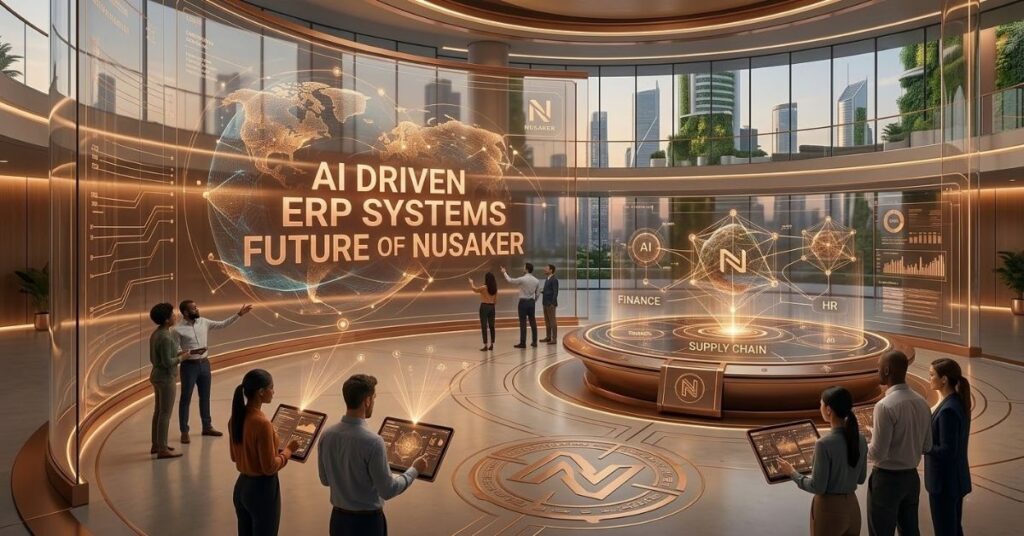
In a world where businesses compete on speed, accuracy, and innovation, relying on outdated systems is no longer enough. Companies today need technology that not only stores data but also understands it, learns from it, and acts on it intelligently. This is why AI driven ERP systems future of Nusaker is becoming a critical topic for modern enterprises.
By combining artificial intelligence with enterprise resource planning, Nusaker can move toward smarter operations, automated workflows, and confident decision-making. This article explains how AI driven ERP systems work, why they matter, and how Nusaker can benefit from adopting them.
AI Driven ERP Systems Explained for Modern Businesses
AI driven ERP systems combine Enterprise Resource Planning (ERP) software with Artificial Intelligence (AI) to manage business operations more intelligently.
Traditional ERP systems mainly record and organize data. In contrast, AI based ERP software can:
- Analyze large volumes of data automatically
- Detect hidden patterns and trends
- Predict future outcomes
- Recommend actions in real time
Because these systems use machine learning, they improve continuously as more data is processed.
Learn more about the technology: Machine Learning
Nusaker ERP Technology and Digital Evolution
Nusaker ERP technology represents the shift from manual and rule-based systems to intelligent, self-learning platforms. As Nusaker grows, managing finance, inventory, operations, and customers manually becomes inefficient and risky.
Anecdote:
Nusaker once relied on spreadsheets to manage inventory and reporting. By the time reports were ready, decisions were already delayed. After implementing an AI-driven ERP solution, Nusaker began receiving real-time insights, automated alerts, and accurate forecasts—turning confusion into clarity.
This real-world example highlights why AI driven ERP systems future of Nusaker is directly linked to efficiency and growth.
Enterprise AI Automation for Smarter Operations
One of the strongest advantages of enterprise AI automation is the ability to eliminate repetitive and time-consuming tasks.
AI-powered ERP systems can automate:
- Invoice processing
- Financial reconciliation
- Inventory updates
- Approval workflows
Related concept: Business Process Automation
For Nusaker, automation means fewer errors, faster execution, and more time for strategic planning.
AI Based ERP Software and Predictive Analytics
AI based ERP software uses predictive analytics to help businesses anticipate future trends instead of reacting late.
Learn more: Predictive Analytics
With predictive intelligence, Nusaker can:
- Forecast product demand
- Identify financial risks early
- Optimize resource allocation
- Improve supply chain planning
This proactive approach gives Nusaker a competitive advantage.
Future of AI ERP and Intelligent Decision-Making
The future of AI ERP lies in systems that don’t just assist humans—but actively support decision-making.
Upcoming AI ERP features include:
- Natural language queries (asking the system questions in simple English)
- Automated recommendations
- Self-optimizing workflows
Related technology: Natural Language Processing
For Nusaker, this means faster decisions backed by real-time, data-driven insights.
Step-by-Step Guide: Implementing AI Driven ERP Systems at Nusaker
Step 1: Identify Business Pain Points
Start by identifying problems such as:
- Manual reporting
- Data inconsistencies
- Slow approvals
- Poor forecasting
Clear goals ensure the right ERP selection.
Step 2: Choose the Right AI ERP Platform
Evaluate systems based on:
- AI automation capabilities
- Scalability
- Integration with existing tools
Popular platforms include:
SAP S/4HANA
Oracle NetSuite
Microsoft Dynamics 365
Step 3: Clean and Prepare Data
AI systems rely on high-quality data. Ensure:
- Duplicate records are removed
- Formats are standardized
- Historical data is accurate
Clean data improves AI learning and predictions.
Step 4: Train Employees and Manage Change
Employee adoption is crucial. Training should focus on:
- Understanding AI insights
- Using dashboards
- Trusting automation
This reduces resistance and improves ROI.
Step 5: Monitor, Optimize, and Scale
After deployment:
- Monitor performance
- Collect user feedback
- Optimize workflows continuously
AI improves with time and usage.
Common Challenges in AI ERP Adoption
Resistance to Change
Employees may fear automation.
Solution: Clear communication and hands-on training.
Integration with Legacy Systems
Old systems may not integrate easily.
Solution: Use APIs and expert consultants.
Initial Investment Cost
AI ERP systems require upfront costs.
Solution: Focus on long-term savings and efficiency gains.
Why AI Driven ERP Systems Are the Future of Nusaker
Investing in AI driven ERP systems future of Nusaker delivers long-term benefits:
- Improved operational efficiency
- Reduced costs through automation
- Faster and smarter decisions
- Scalable growth infrastructure
This is not just software, it is a strategic business investment.
Final Thoughts
The future belongs to businesses that embrace intelligence, automation, and data-driven decision-making. By adopting AI driven ERP systems, Nusaker positions itself for sustainable growth, operational excellence, and long-term competitiveness. The future of Nusaker ERP technology starts with AI, and the right time to act is now.
Frequently Asked Questions
What are AI driven ERP systems?
AI driven ERP systems use artificial intelligence to automate processes, analyze data, and provide smart business insights.
Why is AI driven ERP systems the future of Nusaker?
2. Why is AI driven ERP systems the future of Nusaker?
They improve efficiency, reduce manual work, and help Nusaker make faster, data-driven decisions.
How does AI based ERP software help businesses?
It predicts trends, automates workflows, and delivers real-time insights for better performance.
Is enterprise AI automation suitable for growing companies like Nusaker?
Yes, it helps growing businesses scale operations while reducing costs and errors.